
Ballistic rubber testing helps explain how rubber interacts with projectiles, repeated impacts and the complete shooting range assembly. This review summarizes source documents identifying testing at Picatinny Arsenal, New Jersey, and highlights what the recorded results do—and do not—establish.
Historical archive entry: July 2020. The supplied source documents do not state the actual test date. This article is a CRS review of those records, not an original government publication or a statement of government endorsement.
Download the Picatinny Arsenal ballistic rubber test review (PDF, approximately 437 KB)
The approved review includes readable results tables, all source figures, equipment information and limitations. The receiving customer’s identity is omitted.
Why ricochet mitigation comes first
For CRS, a primary purpose of ballistic rubber is ricochet mitigation within a properly designed range system. Projectile capture is a related but separate outcome: a rubber component may influence a projectile without completely stopping it. Thickness, material construction, reinforcement, backing, ammunition, impact angle and shot distribution all matter.
These records are valuable because they document both favorable observations and the limits of the tested configurations. They should not be read as a universal caliber rating or a substitute for evaluating a complete range installation.
What was tested at Picatinny Arsenal?
The source report identifies ATF Building 7 at Picatinny Arsenal and a 300-meter indoor range. The documented work included oblique-impact ricochet trials, 100 rounds of repeated fire, tracer observations and torch exposure. Ammunition described in the records includes 5.56 mm M855 ball, M193 ball and M856 tracer.
The panel thickness, compound, density, lot and reinforcement are not specified in the supplied report. A separate treated block is described as 8 × 8 × 16 inches; the dimension along its bullet path is not stated. These samples should not be assumed to be identical to another CRS product or test configuration.
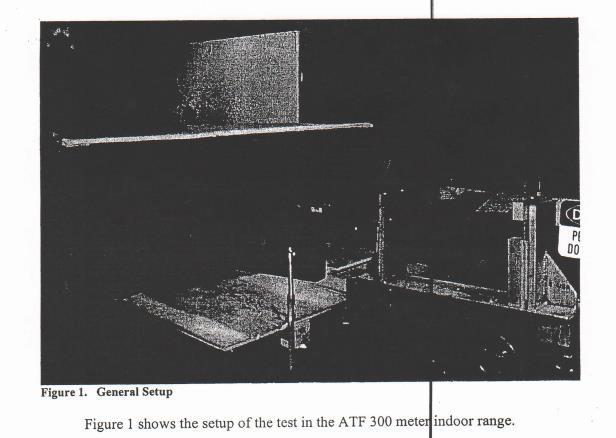
Ricochet testing: impact angle changed the outcome
The recorded ricochet series contains 15 single shots at a listed distance of 13 inches, approximately 33 centimeters. Witness material included Celotex and kraft paper. The table below groups the observations; the PDF provides the individual shot records.
| Recorded angle | Shots | Source observations |
|---|---|---|
| 12° | 3 | Projectile components exited and bounced off a corner piece. Two shots are listed as M855 and one as M193. |
| 13.5° | 2 | M855 penetrator and jacket components exited and bounced off a corner piece. |
| 15° | 4 | Three capture entries; one rubber-fragment event with no witness-paper perforation. |
| 17° | 3 | Captured, as recorded. |
| 22.5° | 1 | Captured, as recorded. |
| 45° | 2 | Captured, as recorded. |
The narrative reports retention of the lead core even in the shallow-angle events where other components escaped. One 15° ammunition entry appears to read M856, while the surrounding discussion frames the series as M855 testing; this discrepancy is flagged in the PDF rather than silently resolved.
The source conclusion discusses a 15° threshold, but the dedicated table contains discrete test angles—not proof of every angle or installation. The angle convention is not fully defined. These results do not establish a universal minimum safe firing angle or complete prevention of ricochet.
Repeated fire: 100 rounds in six bursts
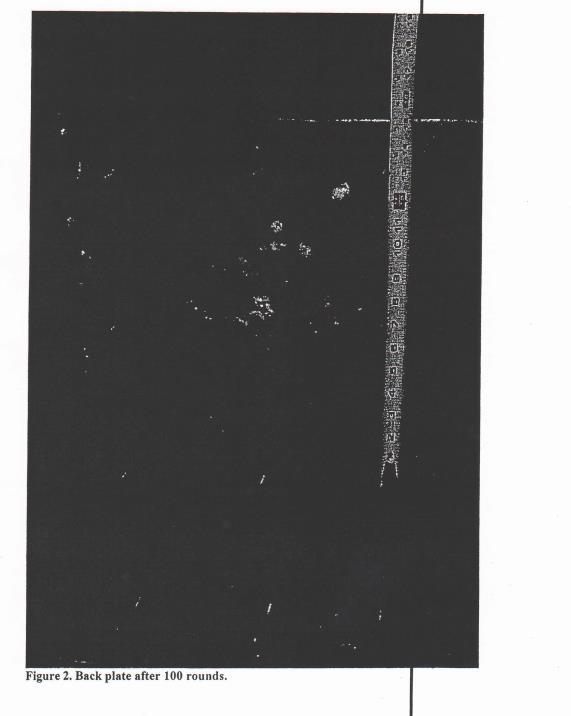
An M249 was used at 10 meters and a recorded 90° impact angle, with 100 rounds fired in six bursts at approximately 725 rounds per minute. The burst counts were 10, 10, 10, 20, 20 and 30 rounds. The source records no noticeable damage at five inspection points; the second burst was marked “did not check.”
The report describes the rubber as remaining intact and performing as designed. The accompanying photographs show the rubber panel and steel backing after the sequence. This is a useful repeated-impact observation, but it does not measure long-term service life, establish superiority over competing products or demonstrate that rubber alone contained every rifle round.
Tracer and thermal observations
Panel tracer trials were reported at a nominal 1.63 meters and 90°. A single tracer in treated rubber was reported to extinguish in approximately one second. Two five-round bursts—one into treated rubber and one into untreated rubber—were reported to extinguish in less than two seconds. The report locates maximum heat between the rubber and steel backing.
In a separate block trial, the source reports that all five M856 tracers were encapsulated, with no holes in the rear cardboard and a brief external flare that extinguished immediately. The block trial’s actual firing distance is not stated in the execution account.
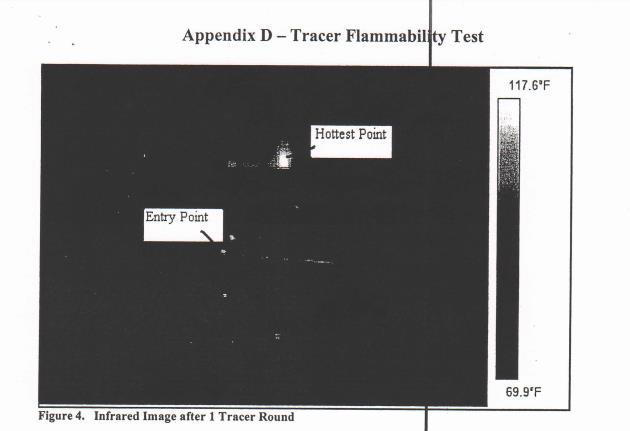
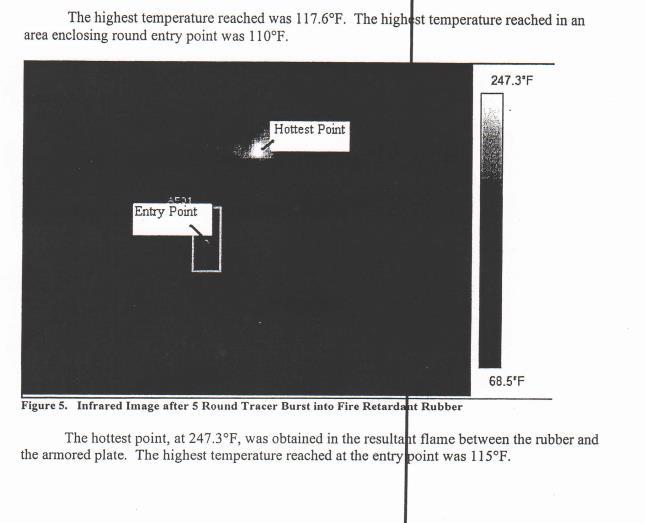
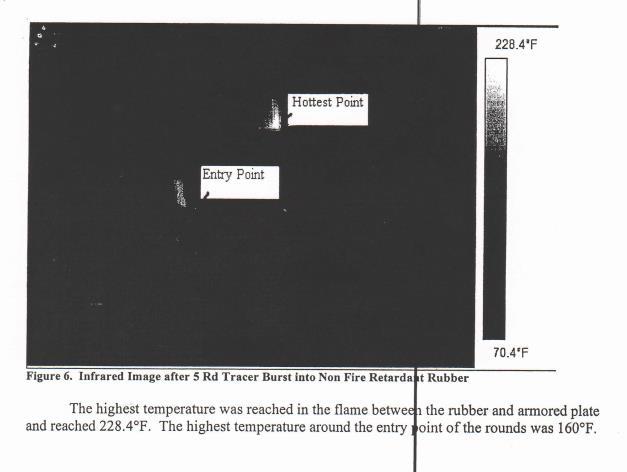
The torch sequence used a reported 30-second application on each sample. The narrative gives approximate flame-out times after removal of seven seconds for untreated rubber and five seconds for treated rubber. Figures 7 and 8 are captioned as views at 15 seconds during exposure. The images exceed the camera’s displayed upper range of 1,076.2°F; they do not establish the material’s maximum temperature tolerance.
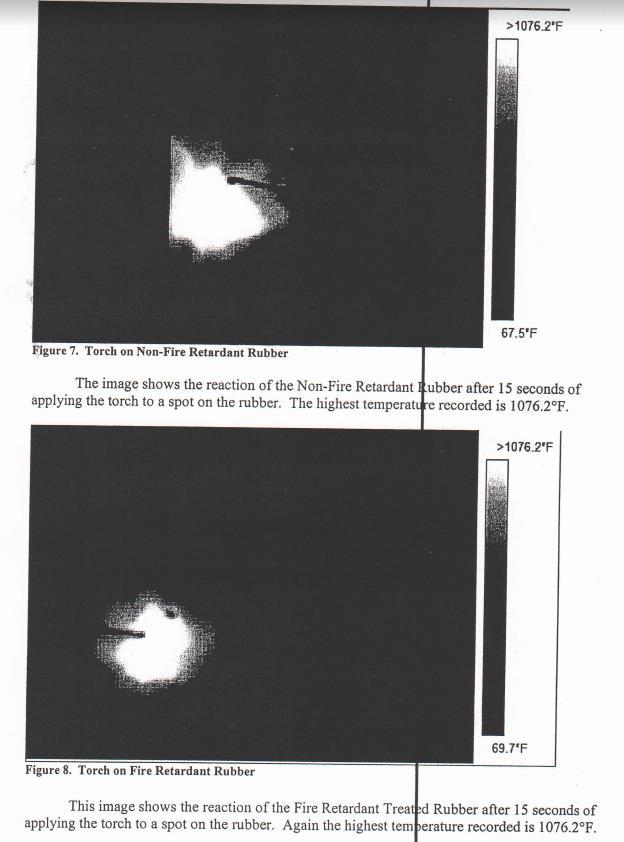
“Treated” describes the historical samples in this report. It is not a flame-resistance claim for current CRS products, a fire classification, or authorization to use tracer ammunition. These observations do not establish smoke toxicity, installed-system fire safety or environmental suitability.
How these findings fit other CRS ballistic rubber testing
The findings support a configuration-dependent view of ballistic rubber performance. They are broadly consistent with CRS customer testing of panels and Titan blocks, where projectile capture and residual velocity varied with the assembly and ammunition. Those separate trials are not interchangeable with the Picatinny setup.
The practical distinction is straightforward: ricochet mitigation is a primary design objective, while complete projectile capture depends on the particular product and installation. These records do not establish an NIJ rating, a universal caliber approval or certification of a current CRS product. A test-plan reference to intended certification is not evidence that certification was granted.
Selecting rubber for a shooting range project
CRS supplies ballistic rubber range components and helps customers discuss material and configuration requirements. The complete system—including backing, containment, mounting, maintenance and permitted ammunition—must be evaluated for the intended use by qualified range professionals. Rubber should not be treated as a substitute for the required projectile-containment system.
For product selection or a project-specific discussion, request a CRS quote and describe the application, ammunition, layout and anticipated shot distribution.
Source records and scope
This article is based on the supplied ten-page Test Summary Report and a separate Ballistic & Flammability Evaluation cover. The PDF preserves the source data, figures, original-plan-versus-execution differences and unresolved details. Individual and receiving-customer identities are omitted. Conclusions are limited to the observations recorded; no government endorsement or current product certification is implied.

